
Most Mystical Places in the World: Legends and Myths and Unexplained Paranormal Phenomena
We all dream of wonderful places – white beaches, crystal-clear seas, exotic landscapes… But would you dare to venture where reality merges with the unknown? Where legends lurk in the shadows and the wind whispers secrets?
In the world, there exist places that have made more than one traveler doubt their eyes and even their sanity. These are places where time seems to stand still, and stories become too real to be considered mere myths.
If you still have the courage to step into the unknown, I invite you on a journey through the most mystical and mysterious places in the world.
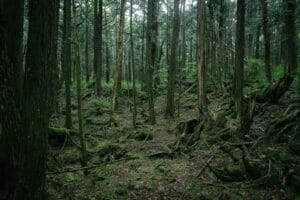
Japan, Aokigahara forest
Aokigahara Forest, Japan
The Aokigahara forest at the foot of Mount Fuji, called “Jukai” (樹海) in Japanese – “sea of trees”, is one of the most impressive places in Japan. This dense volcanic forest is famous for its unique geology – in some places, due to the magnetic properties of volcanic rocks, compasses may show inaccuracies. The forest is characterized by unusual silence and dense vegetation, and its history and atmosphere have inspired countless legends and stories.
Aokigahara forest grew on an ancient lava field formed after Mount Fuji’s eruption in 864. Due to the volcanic soil, a dense, complex terrain formed, abundant with rocks, caves and tunnels. Moreover, due to the unique soil structure, tree roots often protrude above ground, creating a strange and frightening landscape.
One of Aokigahara’s distinctive features is its unusual silence. Dense trees absorb sound, so even in strong winds, peace prevails in the forest. This atmosphere creates an extraordinary feeling often described by both locals and visitors. Due to dense vegetation, sunlight barely penetrates to the forest floor, which adds even more mystery to the area.
Despite grim stories, Aokigahara forest is a popular tourist destination. It abounds in impressive lava caves, such as the Ice Cave (Narusawa Hyoketsu) or Wind Cave (Fugaku Fuketsu), which fascinate visitors with unique natural formations. Hiking tours are also organized in this forest.
Aokigahara is also important from a conservation perspective – it is one of the places where you can observe a unique ecosystem typical of volcanic areas. The forest serves as home to various animals and plants, many of which are unique to Japanese flora and fauna.
Aokigahara forest is a natural wonder entwined with stories and legends. Despite its mysterious atmosphere, it is a place with impressive landscapes, rich biodiversity and deep cultural traditions. This “sea of trees” remains one of the most interesting places for both travelers and researchers seeking to understand the secrets of this unique area.
Legends and Myths
One of the most famous Japanese legends tells of a woman named O-Iwa, whose husband betrayed and poisoned her to marry another woman. After death, her spirit returned as a vengeful onryo (vengeful spirit), persecuting her husband and his accomplices.
Aokigahara has long been associated with various legends and stories. Another legend tells of the “ubasute” ritual that existed in ancient Japan, where families would leave elderly or sick people in the forest to die. Although there is no clear historical evidence, this story has contributed to the forest’s reputation as a mystical and frightening place.
Additionally, Aokigahara is often mentioned in Japanese folklore as a dwelling of ghosts and spirits (yūrei). It is said that wandering spirits seeking peace can mislead travelers, which is why various signs have been placed in the forest urging visitors not to get lost.
Sedlec Ossuary, Czech Republic
The Sedlec Chapel in the town of Kutná Hora is a unique architectural and artistic monument. Its interior is decorated with approximately 40,000 human bones, mostly from victims of 14th-century plague epidemics and 15th-century Hussite wars. The impressive chandelier and ornamental wall compositions created from human remains testify to the complex history of the region and an original artistic solution to immortalize the memory of the deceased.
The chapel is part of the larger Sedlec Monastery complex, which belonged to Cistercian monks. It is believed that Sedlec cemetery became particularly popular after a monk brought holy soil from Jerusalem in the mid-13th century and scattered it over the cemetery grounds. This encouraged people’s desire to be buried in this place.
In the late 18th century, the arrangement of bones was entrusted to local woodcarver František Rint, who gave the chapel’s interior its current form. He carefully arranged the bones into works of art – including the famous bone chandelier using all human body bones, and a reproduction of the Schwarzenberg coat of arms.
Today, Sedlec Ossuary is one of the most visited tourist sites in the Czech Republic, symbolizing not only the inevitability of death but also an original way to honor the deceased.
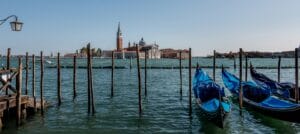
Italy, Poveglia Island
Poveglia Island, Italy
Poveglia Island near Venice has a deep and mysterious history. In the 14th century, it was used as a quarantine zone for plague victims – sick people were isolated to prevent further spread of the disease. It is believed that a large part of the island’s soil consists of ashes left after cremation of thousands of victims.
In the 18th century, Venetian authorities officially converted the island into a quarantine station, and in the 19th century a psychiatric hospital was established there. This hospital operated until 1968, and many chilling stories circulate about it, including rumors of inhumane experiments on patients. Although the truth of these stories has not been proven, they have contributed to Poveglia’s reputation as one of the “most haunted” places in the world.
Today the island is abandoned and inaccessible to visitors without special permission. Despite this, Poveglia remains a significant place in the history of medicine, epidemic management and public health in the Venice region.
Legends and Myths
The Doctor and Bell Tower Legend: According to legend, in the early 20th century, a psychiatric hospital operated on the island where a doctor performed cruel experiments on patients. It is claimed that he performed lobotomies and other painful procedures without anesthesia. Eventually, tormented by the spirits of his victims, the doctor went insane and jumped from the hospital’s bell tower. However, according to stories, he didn’t die immediately – he was suffocated by a mystical fog rising from the ground.
Ghost and Paranormal Phenomena Stories: Many believe that the island is possessed by the spirits of thousands of plague victims and psychiatric hospital patients. There are stories of heard whispers, strange sounds and even visible shadows. Local fishermen avoid approaching the island, fearing to attract bad luck or pull human bones into their nets.
Soil Made of Human Ashes: It is believed that due to the large number of people who died here, the island’s soil is made up of ashes and bone remnants. Some claim that even half of the island’s soil consists of human ashes, which further reinforces the island’s macabre reputation.
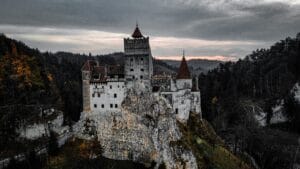
Romania, Bran Castle
Hashima Island, Japan
Hashima Island, also known as “Gunkanjima” (lit. “Battleship Island”), is one of the most intriguing abandoned places in the world. It is located near Nagasaki and was once a densely populated coal mining colony.
In the late 19th century, Japan’s industrialization reached its peak, and coal became the main driving force of the country’s economy. In 1890, the Mitsubishi company acquired the island and turned it into one of the most important coal mining centers. Since the island was only 480 meters long and 160 meters wide, apartment complexes, hospitals, schools and even entertainment venues quickly grew up – all so that workers could live near the mines.
In the mid-20th century, Hashima was one of the most densely populated places in the world – more than 5,000 people lived in just 6.3 hectares. Japan’s first reinforced concrete apartment buildings were built here, designed to withstand typhoons and harsh weather conditions. Life on the island was strictly organized – workers worked long shifts, and their families lived in cramped spaces with minimal amenities.
When Japan switched from coal to oil as its main energy source, the mines became unnecessary. In 1974, coal mining in Hashima was discontinued, and residents left the island within weeks. Since then it has remained completely uninhabited, and many buildings have begun to collapse.
Now Hashima is a tourist-visited place – certain parts of it are open for tours where you can see abandoned apartment buildings, old mining equipment and infrastructure remnants. The island was also used as a filming location – in the 2012 James Bond film Skyfall it inspired the villain’s hideout.
The Dark Side of History
During World War II, Hashima became a forced labor site. Thousands of Korean and Chinese workers were brought here to work – they experienced dangerous working conditions, constant food shortages and cruel punishments. Many of them died from exhaustion or mining accidents. This historical aspect remains controversial – although the island is included in the UNESCO World Heritage list as a legacy of the industrial revolution, Japan has been criticized for hiding the history of forced labor.
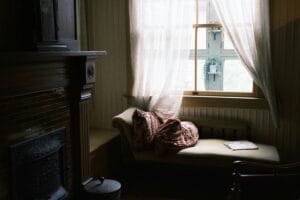
United States of America (USA), Winchester Mystery House
Winchester Mystery House, USA
One of the most mysterious and strangest residences in the world, located in San Jose, California. The building is famous not only for its size and architectural oddities, but also for the legends and paranormal stories associated with it.
The house’s history began in the late 19th century when Sarah Winchester, widow of firearms industry magnate William Winchester, acquired a small farmhouse in San Jose in 1886 and began expanding it. After losing her husband and daughter, she, it is believed, came to believe that her family was haunted by the spirits of people killed by Winchester rifles. It is said that she consulted spiritualists who advised her never to stop building the house – otherwise misfortune would befall her.
Construction continued without interruption for 38 years, until Sarah Winchester’s death in 1922. Since construction was not carried out according to a specific plan and architects were not hired, the building became a labyrinth with confusing corridors, unexpected turns and strange structures.
After Sarah Winchester’s death, the house became a museum and today is one of California’s most popular tourist attractions. Tours are held here, including night tours that attract paranormal enthusiasts.
Strange Architectural Details
- Stairs leading nowhere – some stairs simply end at the ceiling.
- Doors opening to a wall or void – some doors open to nowhere, even into an abyss on the second floor.
- Labyrinthine corridors – it is said that Sarah deliberately created confusing corridors to mislead evil spirits.
- Windows to other rooms – the building has windows looking not outside but into other rooms.
- Numerological motifs – the number 13 is often repeated in the house: 13 steps in some staircases, 13 windows in certain rooms, even 13 holes in sinks.
The final version of the house had 160 rooms, 47 fireplaces, 2,000 doors, 10,000 windows, 6 kitchens and 3 elevators.
Legends and Paranormal Phenomena
Due to its history and unusual architecture, Winchester House has become a popular paranormal research site. There are stories of strange sounds heard, whispers, ghostly figures, moving objects. It is claimed that Sarah Winchester herself was eccentric – she held spiritualist séances, talked to spirits and even slept in different rooms each time to avoid them.
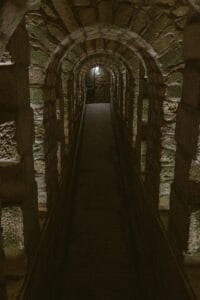
France, Paris, Catacombs
Paris Catacombs, France
This is a network of underground tunnels where the remains of more than six million people rest. This place is entwined with various legends and stories about paranormal phenomena.
In the late 18th century, Paris cemeteries were overcrowded, which caused sanitary problems. To solve this situation, it was decided to move the remains of the deceased to abandoned limestone quarries beneath the city. Thus in 1786 the catacombs were established, which later became a tourist attraction center.
It is important to note that the Paris Catacombs and the Eiffel Tower are in different parts of the city. The official entrance to the catacombs is at Denfert-Rochereau Square, located on the left bank of the Seine, in the 14th arrondissement. Meanwhile, the Eiffel Tower stands on the right bank of the Seine, in the 7th arrondissement. Although both sites are in Paris, they are not close to each other.
The catacombs are open to visitors, but due to narrow tunnels and high visitor traffic, entry restrictions may apply.
Legends and Paranormal Phenomena
Over many years, the catacombs have become a source of various legends and stories about paranormal phenomena. Some visitors claim to have heard unexplained sounds or footsteps, others have felt unexplained cold or as if being watched by someone. There are also stories about ghosts or shadow figures appearing in the tunnels. Although these stories are not scientifically confirmed.
These places are not only tourist attractions but also important monuments of history, architecture and culture. They remind us of humanity’s complex past, technological progress and cultural heritage. Although many of the legends associated with them may be exaggerated or unconfirmed, the true value of these places lies in their authentic stories and cultural significance.
Read more
August 25, 2025
7 most mysterious and strangest islands in the world
7 Most Mysterious and Strangest Islands in the World Our planet is full of incredibly strange and mysterious places, and…

July 30, 2025
How to save 80% on flight prices: The artificial intelligence method
How to Save 80% on Flight Prices: The Artificial Intelligence Method That Beats Google Flights or Skyscanner Have you ever…

March 12, 2025
Thailand: how much do vacations or living there really cost?
Thailand in 2025: Expenses, Experiences, Life So how much does life in Thailand really cost? Without any lyrical digressions and…